
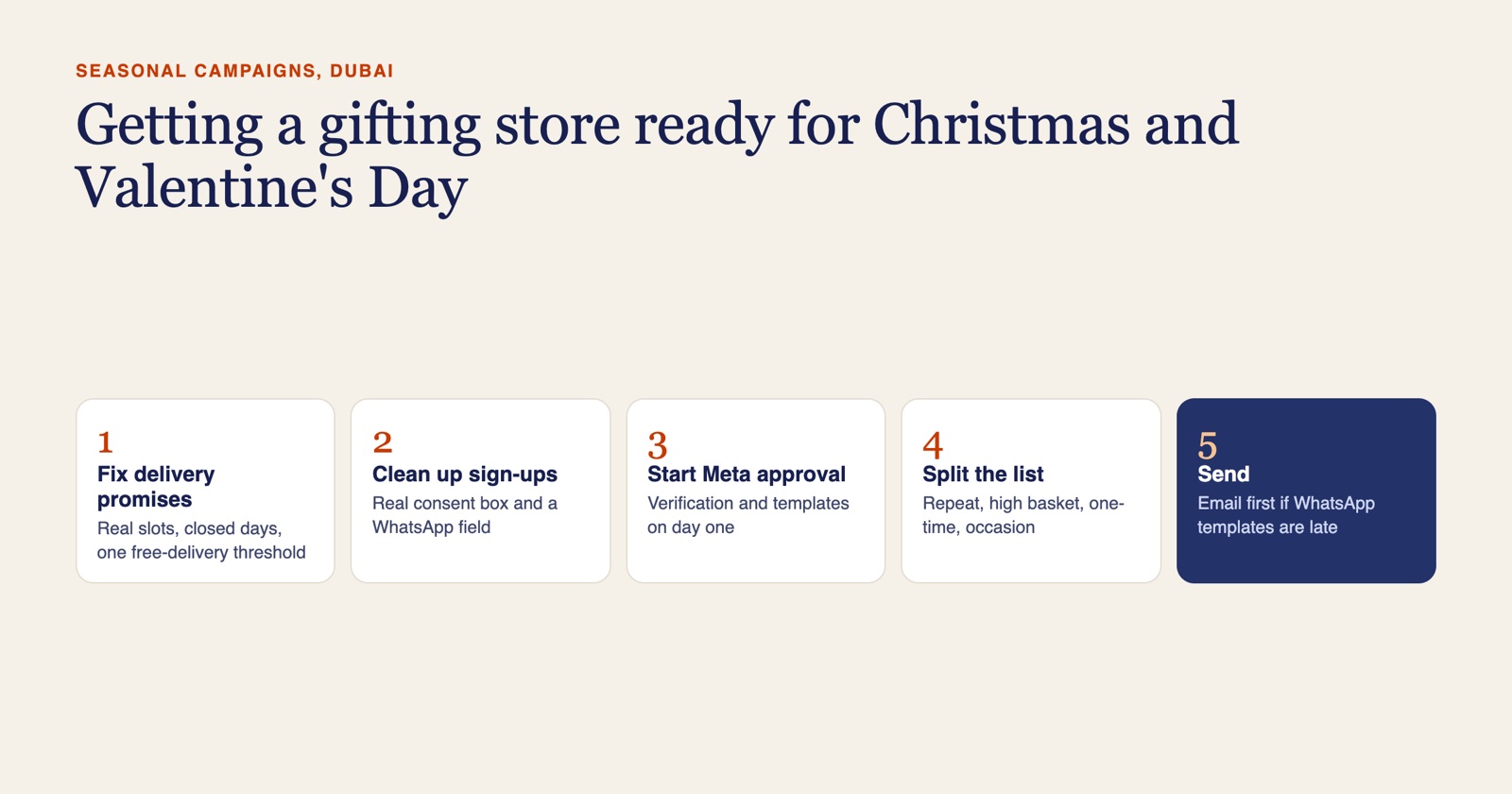
A Valentine's Day campaign for an online store in Dubai only earns its cost if the site it points to keeps its promises. Before anything goes out, make sure product pages promise the delivery slots you can really offer, give one clear free-delivery threshold, and confirm that sign-ups carry real consent and a usable WhatsApp number. Start Meta business verification on day one, because that sets the pace. Then work date by date, nearest peak first.
We reviewed a small UAE gifting store recently, read-only, while it was preparing for Christmas and its biggest date of the year, Valentine's Day. The owner asked for "a very basic CRM" to send emails and WhatsApp messages. The full story of that review is on godesign.ae in what we found when a Shopify store asked us for a CRM. This piece covers one part of it: getting the site ready for the season before a single campaign is sent.
Why should the nearest peak decide the order of work?
Because the campaign date will not move, and most site fixes could happen any week. A gifting store can have a dozen things it wants to improve. If Christmas comes before Valentine's Day, every task gets one question: does Christmas need this?
For the store we reviewed, the answer sorted the list quickly. Consent and sign-up fixes, the delivery promise and a Christmas email had to land first. WhatsApp automation, review requests and the Valentine's templates could follow, because they would still be ready in time for February. We proposed a three-week plan in that order, with each week signed off before the next began.
Does your delivery promise match your real delivery slots?
Check this before anything else, because a seasonal shopper is buying for a date. On the store we looked at, product pages promised very fast same-day delivery. The delivery app at checkout only offered next-day slots in fixed windows, and one day of the week was closed.
Around Valentine's Day that gap costs more than a lost sale. A gift that arrives a day late is a complaint, and in a market with luxury players above and mass-market sellers below, an unhappy customer has plenty of other places to go next year.
What to check:
- The delivery wording on product pages, banners and FAQs matches the slots the checkout really offers.
- Closed days and cut-off times are written down where the customer sees them before checkout, not only in the slot picker.
- Only one delivery app is installed. We found two running at once, with one flagged by Shopify.
- Peak-day rules are decided now: is there a last order date for the 14th, and does the site say so?
Is your free-delivery threshold clear everywhere?
It should be one number, said the same way on every page. The store's cart bar showed a confusing negative amount and used a different threshold from the one written on product pages.
Pick the threshold, then check the product pages, cart bar, checkout, campaign copy and any WhatsApp replies your team sends from memory. If the threshold changes for the season, change it in all of those places on the same day.
Are your sign-ups real enough to send a campaign to?
Often not, and the reasons are small. On the sign-up path the review found:
- A "send us your details on WhatsApp" button linked to a placeholder number, so those sign-ups went nowhere.
- The form saved the WhatsApp number into the customer's free-text note, where neither Shopify automations nor a WhatsApp platform can read it.
- Every sign-up was marked as agreeing to email marketing whether the box was ticked or not.
- The welcome discount for joining the list was also shown in the site header and worked for anyone, so it gave nobody a reason to sign up.
- The customer list held test records and many people who had never subscribed.
The consent problem matters most. A list where everyone is marked "subscribed" regardless of what they ticked is a liability, and sending a campaign to it puts the store's sender reputation and its WhatsApp number at risk. We recommended a consent box per channel, a proper WhatsApp number field at checkout and on the sign-up form, removing test records, and keeping the welcome code for people who actually join.
Why start Meta verification on day one?
Because it is the step you cannot speed up. WhatsApp broadcasts on the Business API need a verified Meta business and approved message templates, and both depend on Meta's review, not on your team.
So we put it on the first day of the project, alongside the consent fixes, and planned around it. If you are still deciding on the WhatsApp side, our guide to what WhatsApp costs to add to a Dubai website or store covers the build and running costs.
What if WhatsApp templates are not approved in time?
Send the campaign by email first. Shopify's own email already reaches everyone who opted in to email, and on the store we reviewed the welcome email and abandoned-checkout email were already live. So we planned the Christmas campaign as email in week one, with WhatsApp following once the templates were approved.
Email-first is a sensible default for the first season anyway. It costs little to send and shows you who opens and buys before you start paying Meta about AED 0.183 per marketing message.
Who should the campaign go to?
Not everyone at once. We set up four segments in Shopify for the store:
| Segment | Who is in it | What they should get |
|---|---|---|
| Repeat buyers | Customers with more than one order | Early access or a reminder of what they bought last time |
| High basket value | Customers whose orders sit well above the store average | Premium gift sets and bespoke options, not a discount |
| One-time buyers | One order, nothing since | A clear reason to come back for this date |
| Occasion interest | People who told you about a birthday, anniversary or date | A message built around their occasion |
Each person only gets the campaign on the channel they agreed to. Someone who opted in to email but not WhatsApp hears from you by email.
How do you make this season's campaigns reusable?
Build each one as a template the team can copy. A gifting store runs the same pattern several times a year, and a campaign written from scratch under pressure is usually worse than the last one.
We proposed delivering the seasonal campaigns as copyable templates for email and WhatsApp, with the date, offer, imagery and segment swapped each time. Valentine's templates were scheduled for the final week of the plan, after Christmas had gone out and been checked.
What does a week-by-week countdown look like?
A simple version, counting back from the peak date:
| When | What to finish |
|---|---|
| 8 weeks out | Start Meta business verification. Fix sign-up consent, the WhatsApp field and test records |
| 6 weeks out | Delivery wording, closed days and the free-delivery threshold agreed and live on every page |
| 4 weeks out | Segments built. Email campaign drafted. WhatsApp templates submitted |
| 2 weeks out | Test orders on real slots. Last order date published. First email sent |
| Final week | WhatsApp campaign to opted-in segments, or a second email if templates are still waiting |
When both dates fall inside the same countdown, run the Christmas one first and start the Valentine's one as soon as Christmas has gone out.
The site work in this list, meaning delivery wording, the cart bar and theme fixes, usually sits with your web developer. On a phone those details matter even more; see what has to work on a mobile ecommerce store.
Frequently asked questions
When should a Dubai online store start preparing for Valentine's Day?
Earlier than most do, and after Christmas is sorted if Christmas comes first. The site fixes, the consent clean-up and the Meta approvals take the longest, so start those now and leave the campaign copy for the final weeks.
Can we run a WhatsApp campaign without Meta business verification?
Not on the WhatsApp Business API. Broadcasts to customers need a verified business and approved message templates. That is why we start verification on the first day of a project and send the first campaign by email if approval runs late.
How much does a WhatsApp campaign cost to send in the UAE?
Meta charges about AED 0.183 per marketing message to a UAE number, so one message to 1,000 opted-in customers is roughly AED 183. Platform fees sit on top, and some platforms start at about AED 55 a month with Meta fees passed through.
Which customers should a seasonal campaign go to?
Split the list before you write anything: repeat buyers, high basket value, one-time buyers and people who told you about an occasion. Each group gets a different message, and each person only hears from you on the channel they agreed to.
Can we reuse this year's campaigns for Mother's Day and next Christmas?
Yes, if they are built as templates rather than one-off messages. We set up each campaign so the team can copy it, change the date, offer and imagery, and send it again without a developer.
Get your store ready before the next date
Tell us which date you are working towards, what platform the store runs on and what you send to customers today. We will review the sign-up path, the delivery promise and the cart as a customer would, and tell you in writing what to fix first. See our Shopify development service, send us a brief, or message us on WhatsApp.