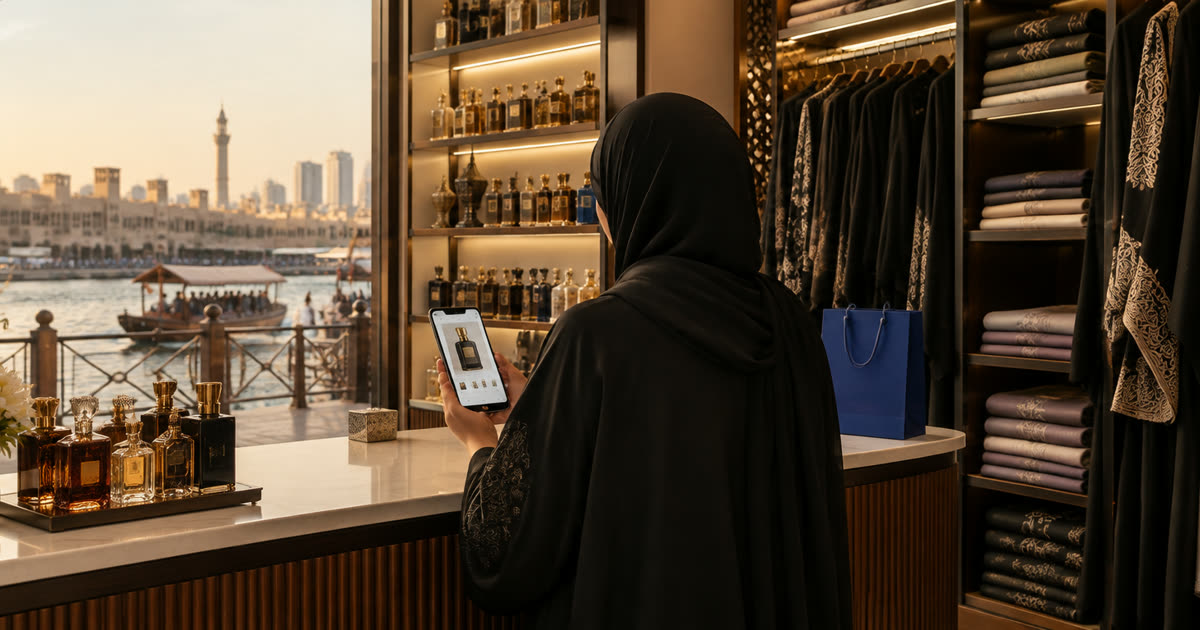

A mobile friendly ecommerce website lets a shopper in Dubai find a product, choose a size or colour, pay and see a confirmation on a phone without zooming, retyping or going back. Most stores pass the first glance on a handset. They fail further in, at the filter panel, the variant picker, the cart and the payment step, and that is where the sale is lost.
This piece is for owners of Dubai and UAE online stores. For the general case for responsive layouts on any website, see responsive website design in Dubai.
What makes an ecommerce website mobile friendly in Dubai?
The whole buying path works with one thumb, in English and in Arabic. The homepage is the easy part. The trouble sits in the screens that hold state, where the page changes as the shopper makes choices.

These are the places we look first when a store owner says the site "must be mobile friendly":
- Filters and sorting. A filter panel that works on a wide screen can cover the product grid on a phone, or leave the shopper unable to clear a choice.
- Variant pickers. Size, colour and bundle options too small to tap accurately, or that do not update the price and image.
- The payment step. The card form and any 3D Secure bank screen have to behave on a phone. Our ecommerce development builds test gateway payments with real cards for this reason.
- The Arabic version. A right-to-left store is a second layout, not a flipped copy of the first. Arabic is a second layout explains why.
How should a mobile responsive store layout be built?
Design the phone layout first and scale up, on a theme written for your catalogue rather than a bought one with the colours changed. How that looks depends on the platform.
On Shopify, we code the theme and keep the app list short, because every app can add weight to the page. On WooCommerce, the layout sits in a hand-built WordPress theme, the same approach as our WooCommerce development. We also build on Magento and fully custom stores when the catalogue calls for it.
Two projects from our work page show what this means in practice.
Raena Beauty was a beauty brand launching to a Gen Z audience that arrives from a phone, and arrives all at once. We built the storefront mobile first, made the sign-up funnel part of the store, and it stayed up through launch day.
Frankfurter Kaffeerösterei is a WooCommerce coffee store that had outgrown stock WooCommerce. We wrote product filtering for the way people shop for coffee and moved the live store across on staging without losing customer records.
Neither was sold as a "mobile" project. Between them they show what this comes down to: a layout designed from the phone upwards, and filtering built for the catalogue.
What slows a mobile friendly store down?
Mostly what loads on every page rather than the page itself. A phone on a mixed mobile connection pays for every extra script, oversized image and web font, and on a store that cost repeats on every product and category page.
The usual causes are extensions that each add scripts, product images uploaded at camera resolution, and tracking tags added over the years. On WooCommerce, caching has to be set up so it never freezes the cart or checkout. On Shopify, the fix is often what you remove, and doing in theme code what an app does now.
We measure product and cart pages on a mid-range phone, not a studio desktop, before launch. We do not promise a score. We promise the work is checked on the device your customers hold.
Is your store losing customers on a phone? Send us the store link and what you suspect is wrong. We reply within one business day with scope, a timeline and a fixed quote. Request a store review.
How do you make mobile checkout faster?
Cut what a customer has to type or tap to pay you. A fat-finger error at checkout costs the sale, and no amount of polish elsewhere makes up for it.
- Fewer checkout fields, guest checkout available, and the right keyboard for each field (numeric for phone numbers, email for email).
- Apple Pay and Google Pay where your gateway supports them, so nobody types a card number on a small screen.
- Tabby and Tamara instalment messages on the product page, not only at the end of checkout.
- Delivery options that follow the emirate, with cash on delivery if you offer it.
- WhatsApp and call buttons within thumb reach, because a shopper with a question should be able to ask it instead of leaving.
"Amazing job integrating Apple and Google Pay onto my website for a faster checkout. Delivered in a timely manner and was very easy to work with, even across a different time zone."
Gabriel G., via Freelancer
That job was a payment integration rather than a mobile redesign. It does show that we build and test checkout rather than leave it to the theme.
Should you hire a specialist instead of using a template or a freelancer?
If the store is your business, yes. A mobile friendly store is many small decisions someone has to own, and a template cannot make them for your catalogue. It gives you a layout. It does not give you filters that suit how your customers shop, payment steps tested on a phone, or an Arabic version that was designed rather than mirrored.
A freelancer can do all of that, until they are unavailable, and that is often when stores arrive with nobody holding the accounts. With us:
- Scope is written down first, including every template that has to work on a phone, before the quote.
- You own the repository, hosting and domain credentials from day one, in your name.
- A written timeline is fixed before the project starts, and a 90-day warranty covers anything that breaks because of how we built it.
We are a team based in Dubai Media City. You can meet us on the About page.
"We had our web blog and web store created. We are more than satisfied with the result. Not only the technical aspects, but also the design has been realized on the highest possible level."
CM-Audio Flöter Technology Service, via Trustpilot
That review was for a blog and web store build, again not a mobile job by title.
How much does a mobile friendly online store cost in Dubai?
Every store we build is mobile first, so there is no separate "mobile" price. Our ecommerce packages:
| Package | What you get | Delivery | Price |
|---|---|---|---|
| Starter Store | Shopify or WooCommerce, up to 50 products, UAE gateway, Tabby or Tamara, 5% VAT, courier rates | 3-4 weeks | AED 4,500 (USD 1,225) |
| Growth Store (most chosen) | Custom-coded theme, up to 500 SKUs, Arabic storefront, Google Merchant feed, GA4 ecommerce, abandoned-cart flows | 6-8 weeks | AED 7,900 (USD 2,150) |
| Scale Store | Magento, headless, multi-store or B2B pricing, ERP sync | 10-16 weeks | from AED 18,500 (USD 5,040) |
Fixing an existing store is quoted after a review, because it depends on how many templates are broken. If you are still choosing a platform, Shopify vs WooCommerce in the UAE compares them for local stores.
Frequently asked questions
What makes an ecommerce website mobile friendly?
A shopper on a phone can find a product, choose a size or colour, pay and see a confirmation without zooming, retyping or going back. That means filters that do not cover the product grid, variant pickers large enough to tap, a short checkout with the right keyboards, and a payment step tested on a phone.
Is a responsive theme enough to make my store mobile friendly?
Not on its own. A responsive theme resizes the layout, but the pages that lose sales on a phone are the filtered catalogue, the variant picker, the cart and the payment step. Those need to be checked with real products and a real test order, whatever theme sits underneath.
Can you add Apple Pay and Google Pay to my store?
Yes, where your gateway and platform support them. Wallet payments mean the customer does not type a card number on a small screen, which is one of the simplest ways to shorten a mobile checkout. We test the full payment and refund path on real phones before launch.
Can you make my existing Shopify or WooCommerce store mobile friendly without a rebuild?
Often, yes. We review the store first and tell you whether targeted fixes to the broken templates will do or whether a rebuild is the cheaper path. You get that answer in writing before any work starts.
How much does a mobile friendly online store cost in Dubai?
Our Starter Store is AED 4,500 (USD 1,225) for up to 50 products with a UAE gateway, Tabby or Tamara, VAT and courier rates, in 3 to 4 weeks. The Growth Store is AED 7,900 (USD 2,150) with a custom-coded theme, up to 500 SKUs and an Arabic storefront, in 6 to 8 weeks. Every store is tested on real phones before launch.
Get a mobile friendly store quote
Tell us which platform you are on, what is going wrong on a phone, or what you want built. We reply within one business day with scope, a timeline and a fixed price in AED. Send us a brief, call +971 58 903 1983, or message us on WhatsApp.