An ecommerce blog for a Dubai online store earns its place when it answers the questions a buyer asks before choosing, links straight to the products that answer them, and is ready before the season it was written for. That means buying guides and routines rather than brand news, product cards inside every post, an Arabic version where you sell in Arabic, and a publishing plan built around Ramadan, Eid and the big sale dates.
This piece is written for beauty and skincare stores, because that is where we see the most questions before a sale. The same rules hold for coffee, supplements, gifting and most catalogues. For the general case of what any business blog website needs, from the CMS to lead capture, see GoDesign's guide to building a blog website.
Does an online store in Dubai need an ecommerce blog?
Yes, if your customers ask questions before they buy. A skincare shopper wants to know which cleanser suits oily skin in the summer, whether a serum works under sunscreen, or how to build a routine for skin that dries out in air-conditioning all day. A product page cannot hold all of that without burying the add-to-cart button.
A blog answers those questions on your own domain, in your own voice, and then points the reader to the product that fits. Search engines can show the guide to someone who has not yet heard of your brand. A product page rarely gets that chance.
If all you would post is "new arrivals" and "we are now on Instagram", skip it. A collection page and your social accounts do that job better, and a blog with three news posts from last year makes a store look closed.
Ecommerce blog ideas: what should a skincare store in Dubai publish?
Publish what a buyer needs to know before choosing, and keep each post tied to products you sell. The formats that do this best:
- Buying guides. "Which moisturiser for oily skin in a humid summer" or "Choosing a sunscreen you will actually wear every day".
- Routines. Step-by-step posts for a morning or evening routine, with each step linked to the product that does it.
- Ingredient explainers. What an ingredient does, who it suits and which of your products contain it.
- Answers to the questions customers send. The ones your team answers on WhatsApp and Instagram again and again, written up once so you can send a link.
- Comparisons within your range. Two of your own products side by side, so the shopper picks one instead of leaving to think about it.
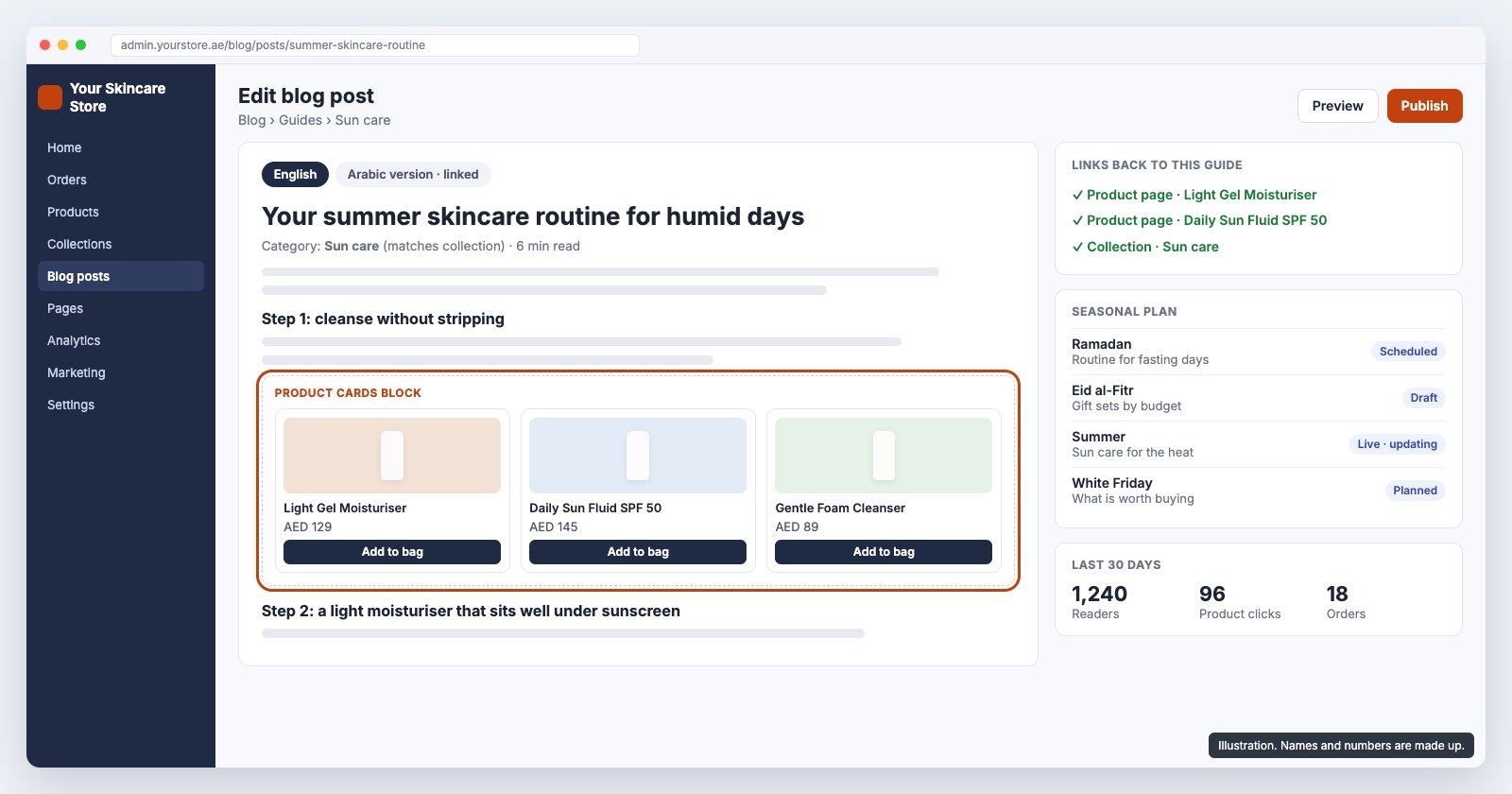
- Seasonal guides. Skincare during Ramadan fasting, Eid gift sets, summer heat, and gift guides for White Friday and Valentine's Day.
What to leave out: supplier descriptions pasted in again, posts written only to hit a word count, and anything you would not be happy to see quoted back by a customer in a WhatsApp chat.
How should blog posts link to your product pages?
Through links in both directions, built into the templates rather than added by hand each time. Each post should carry two to four product cards inside the text: image, name, price and an add-to-cart or view button. A plain text link is easy to miss. A card next to the paragraph that explains why the product fits is not.
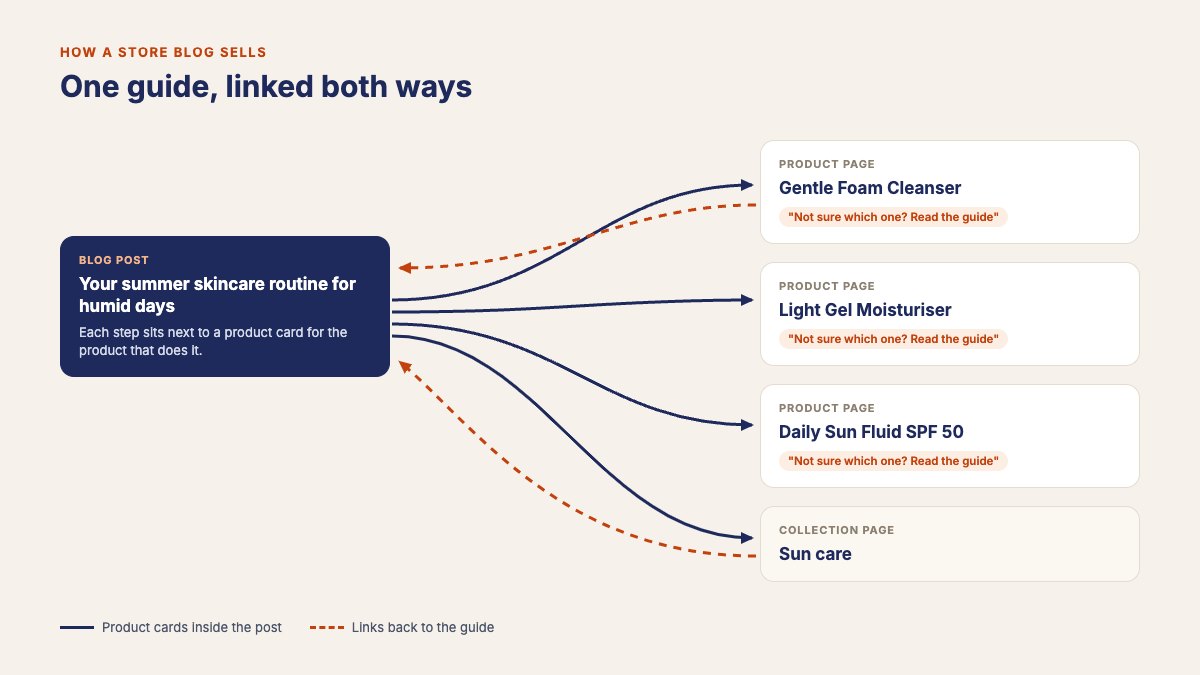
The return path matters as much. A product page can carry a short line such as "Not sure which one suits you? Read the guide", and a collection page can open with a link to the buying guide for that shelf. That way a shopper who lands on the product from an ad can still find the advice, and one who lands on the guide from search can still find the product.
Two smaller decisions make this work over time:
- Categories follow collections. Blog categories named after your shelves (cleansers, sun care, gift sets) let a reader move from guides to products in the same place. Categories by month or "news" do not.
- Structure where posts repeat. When we built Dash & Pinch, a recipe site run by one writer, every recipe got its own fields for ingredients, steps and timings, so each one came out in the same shape. A skincare routine is the same kind of content: steps, products and skin type. Giving those their own fields keeps every routine consistent and lets the product cards fill themselves.
We also tag clicks from a post to a product in GA4, so you can see which guides lead to an add-to-cart and an order.
Should the blog be in English, Arabic or both?
Match the blog to the store. If you sell in Arabic, the blog needs Arabic too, though not every post on day one.
Start with the buying guides that link to products on your Arabic storefront. Then write new Arabic posts for the questions Arabic-speaking customers ask, rather than running every English post through a translation tool. Each English and Arabic pair is linked with hreflang tags, so search engines show the right language to the right reader.
The Arabic blog template is a second layout, not a mirror of the English one. Product cards, tables and step lists all have to read right to left. Our piece on why Arabic is a second layout covers what changes.
Selling online with no blog, or a blog nobody reads? Send us the store link and tell us what you sell. We reply within one business day with what we would publish first, how it would link to your products, and a fixed quote. Request a store review.
How do you plan posts around Ramadan, Eid and the sale dates?
Work back from the dates. A guide published the week a season starts is usually too late, because search engines need time to find and rank a new page. Publish a few weeks ahead, and remember that Ramadan and both Eids move earlier each year.
| Season | What to publish | Where it links |
|---|---|---|
| Ramadan | A routine for fasting days and late nights | Gentle cleansers, moisturisers, lip care |
| Eid al-Fitr and Eid al-Adha | Gift guides by budget and by person | Gift sets and bundles |
| Summer | Sun care and oily-skin guides for the heat | Sunscreens, light moisturisers |
| White Friday | A short list of what is worth buying in the sale | Sale collection |
| Dubai Shopping Festival | Gift and stock-up guides | Bundles and best sellers |
| Valentine's Day and Mother's Day | Gift guides | Gift sets, gift wrapping |
Do not start a new post each year. Update last year's guide with current products and prices, keep the same address, and change the date. The page keeps the links and search history it built last year, and the products inside it stay current.
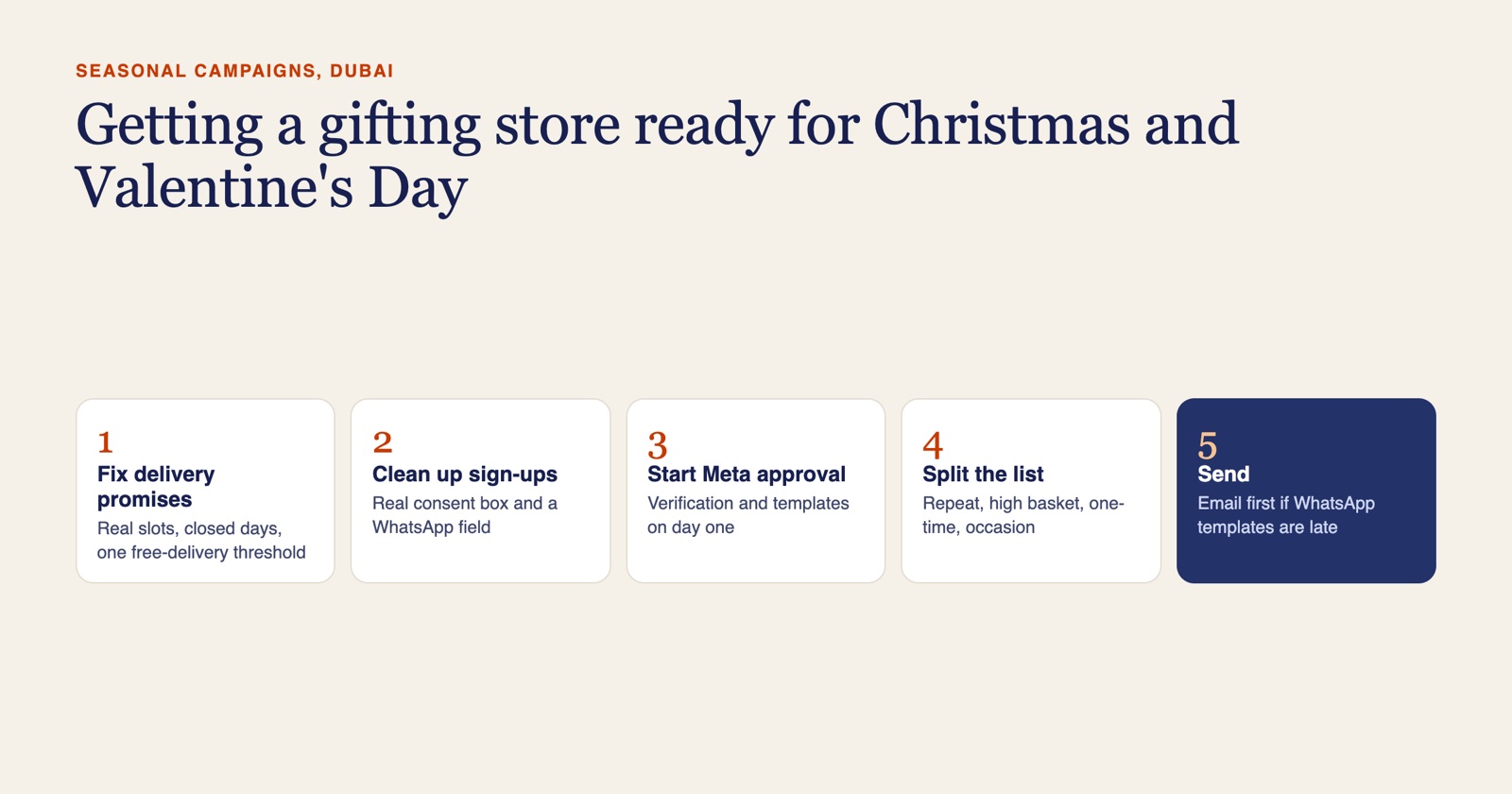
A blog post is only one part of a season. The store underneath has to keep the promises the post makes. Our checklist for getting a Dubai store ready for Christmas and Valentine's Day covers delivery wording, thresholds and sign-up consent.
How do you add a blog to a Shopify, WooCommerce or Wix store?
Use the blog built into the store, on the same domain, not a separate site or subdomain. That keeps the links between posts and products simple, the cart one click away, and any search credit the blog earns on the domain that sells.
How it is built depends on the platform:
- Shopify has a blog built in, with articles and tags. Product cards inside a post usually need a custom section in the theme, which we build to match the store. Our Shopify development work includes the blog template when a store needs one.
- WooCommerce runs on WordPress, which is a publishing platform first. The editor is the strongest of the three, and product blocks can sit anywhere in a post. See our WooCommerce development service.
- Wix has a built-in blog that suits a small catalogue with a few posts a month.
"We had our web blog and web store created. We are more than satisfied with the result. Not only the technical aspects, but also the design has been realized on the highest possible level."
CM-Audio Flöter Technology Service, via Trustpilot
Who writes the posts and keeps them going?
Your team knows the products and the questions customers ask, so the best posts usually start with them. We build the blog so that writing is the only job left: a post template that matches the store, product cards that drop into the text, categories mapped to your collections, an Arabic version where you need one, and a short hand-over guide so anyone on the team can publish without a developer.
If you would rather hand the writing over too, we can plan the first set of guides with you and write them from your product knowledge.
"I loved her work. Perfect communication, beautiful work. If I need, I will hire her again."
Szilard, Slovakia, via Freelancer, on a blog website build
Frequently asked questions
Does an online store in Dubai need a blog?
It does if customers ask questions before they buy, which is true for skincare, beauty, supplements, coffee, electronics and most gifting. A blog answers those questions on your own domain and sends the reader to the product that fits. If all you would publish is new-arrival news, a collection page does that job better.
How often should an online store post on its blog?
Steady matters more than frequent. A couple of useful guides a month that each link to the right products will do more than a weekly post written to fill a slot. Before each season, update the posts that sold last year so they are current when shoppers arrive.
Can you add a blog to an existing Shopify or WooCommerce store?
Yes. Both platforms have a blog built in. We add a post template that matches the store, product cards that can sit inside a post, categories that follow your collections and the Arabic version if you sell in Arabic. The store keeps running while we build on staging.
Do blog posts need to be in Arabic as well as English?
Only if you sell to Arabic readers. If the store has an Arabic storefront, start by translating the buying guides that link to Arabic product pages, then write new Arabic posts for the questions Arabic-speaking customers ask. Each pair is linked so search engines show the right language.
Does an ecommerce blog increase sales, or only traffic?
It brings sales when each post links to products and you measure it. We tag the clicks from a post to a product in GA4, so you can see which guides lead to an add-to-cart and an order, and which ones only bring readers.
Get a blog that sells for your store
Tell us what you sell, which platform the store runs on and whether you sell in Arabic. We reply within one business day with scope, a timeline and a fixed price in AED. See our ecommerce development services, send us a brief, or message us on WhatsApp.